Webhooks
Webhooks allow you to build or set up integrations that subscribe to certain events in IP Fabric. When one of those events is triggered, IP Fabric will send an HTTP POST payload to the webhook configured URL. Webhooks can be used to send notifications to the messaging tools of your choice or update an external issue tracker. You’re only limited by your imagination.
Add Webhook
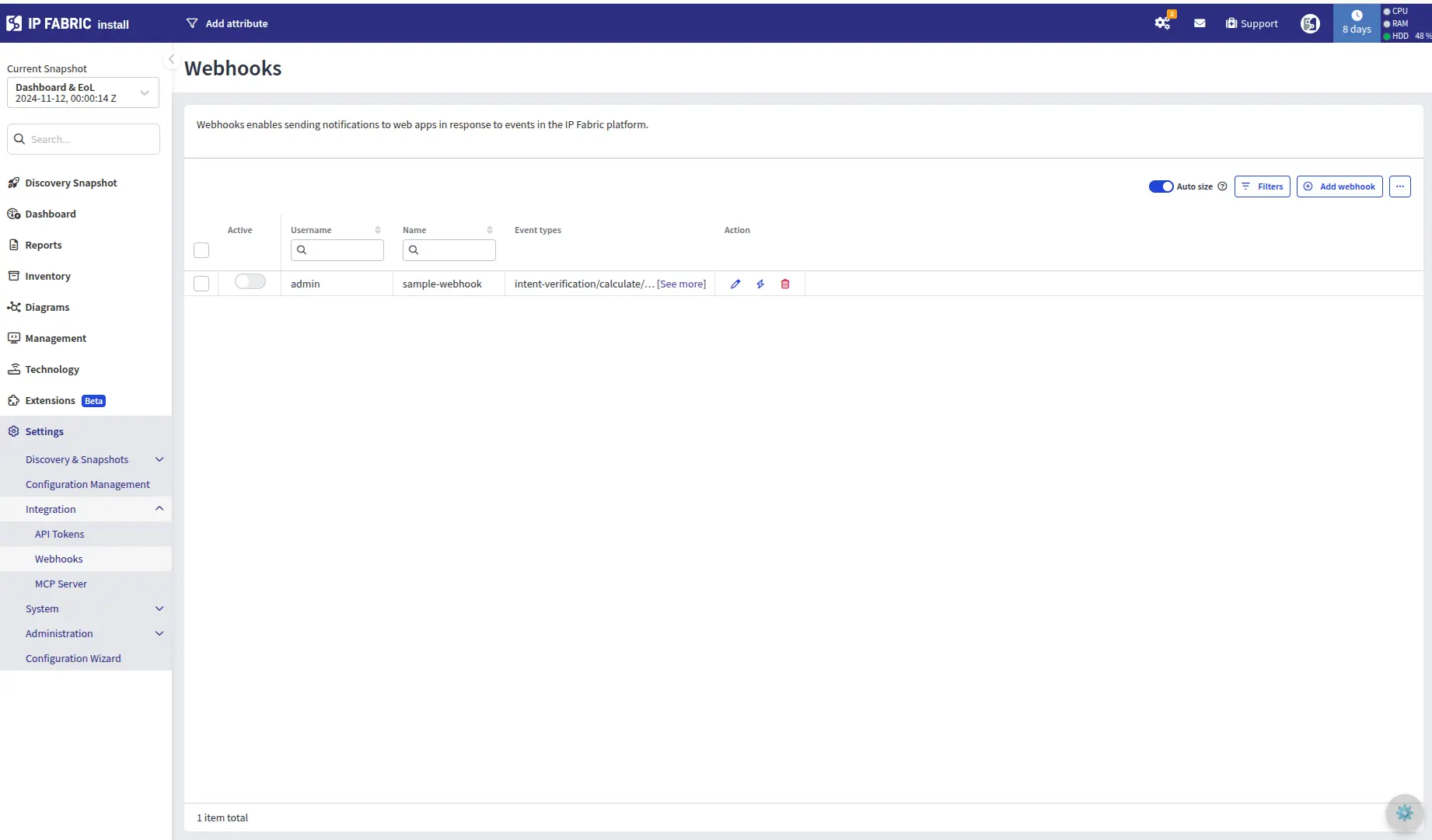
To set up a webhook, navigate to Settings → Integration → Webhooks.
Events
Whenever IP Fabric generates an event, it checks the list of active
webhooks and determines which of them (if any) are subscribed to the
event that has just occurred. Then, IP Fabric sends the webhook payload to
the corresponding URLs. The receiving party should confirm the payload with
an HTTP status 2xx response and can process the payload as needed. If the
receiving party doesn’t confirm the payload (because it is not
reachable, it returns a bad status code, or the delivery times out), IP Fabric
tries to deliver the webhook payload again 1, 2, 5, and 10 minutes
after the initial delivery. If IP Fabric cannot deliver the webhook in
these five attempts, it gives up. All delivery attempts are recorded in
the webhook delivery history (see Recent Deliveries below).
Recent Deliveries
Open the Recent deliveries tab on the Webhooks page to browse the delivery history of every webhook in one place. Each row is a single outbound delivery attempt, newest first.
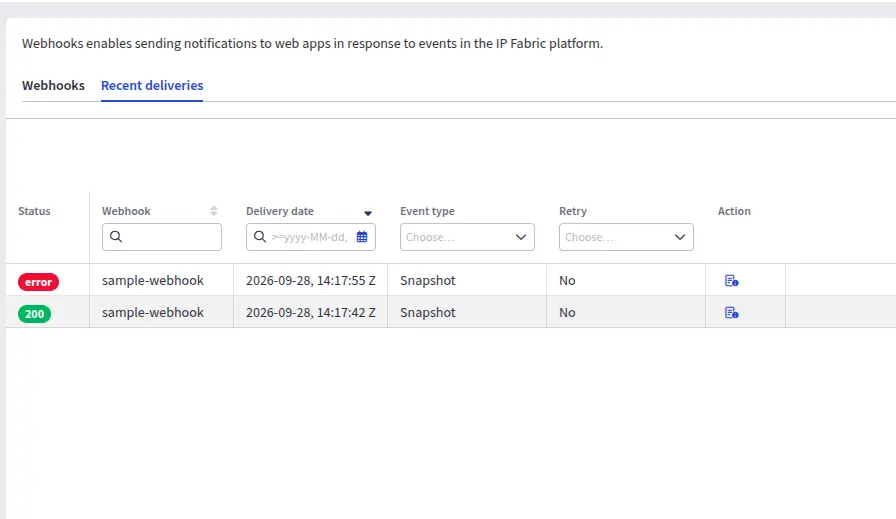
The table shows the following columns:
- Status – the HTTP response status code the endpoint returns (for
example,
200), orerrorwhen the attempt fails before receiving a response,
- Webhook – the name of the webhook that produced the delivery,
- Delivery date – when IP Fabric made the attempt,
- Event type – the event that triggered the delivery (
SnapshotorIntent verification),
- Retry – whether the attempt was a retry (
Yes) or the first delivery attempt (No),
- Action – opens the delivery detail dialog.
Filter the list by Webhook, Delivery date, Event type, and Retry to narrow down the attempts you want to inspect.
Use the Action button on a row to inspect a single delivery. The detail dialog displays the target URL, time, request body, payload hash, response headers, status, and error message when the delivery fails.
To reach this tab pre-filtered to a single webhook, use the View all deliveries link in the webhook Edit view. The click here link in the confirmation shown after a Test Webhook also opens the Recent deliveries tab filtered to that webhook.
Triggers
By default, a webhook triggers on every event of the types it subscribes to. For finer control, switch the webhook to advanced trigger selection. Then select exactly which events should trigger it.
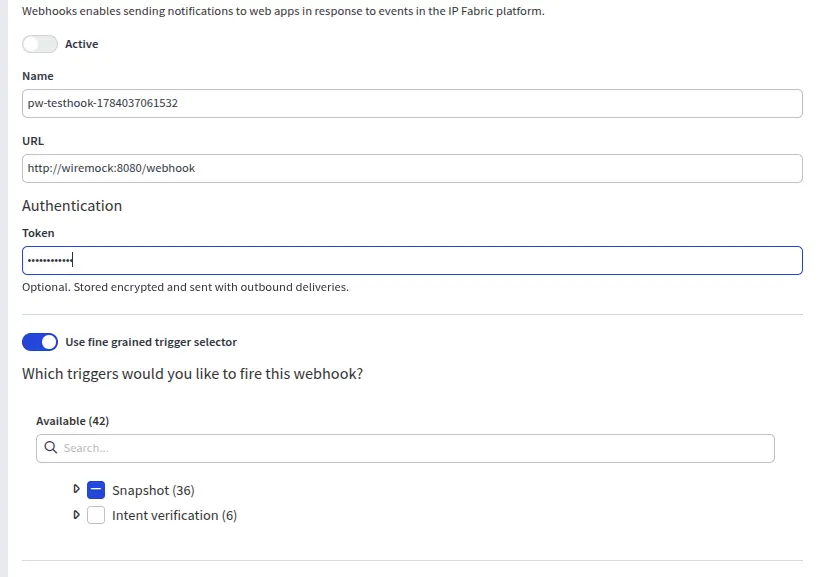
IP Fabric currently exposes two groups of triggers:
- Snapshot events –
discover,clone,delete,download,load, andunload,
- Intent verification events –
started,completed,failed,resumed,resumed (stopping), andstopped.
You can subscribe broadly (for example, all snapshot events) or narrowly (for
example, only a snapshot discover that has completed). A trigger with no
action or status set matches every value of that field.
Note
Custom payloads, custom headers, outbound authentication tokens, and custom certificate authorities are available only for webhooks that use advanced trigger selection. Legacy webhooks (subscribed by type) keep their original behavior.
Payload Hash
Since the webhook payload might be delivered over untrusted networks,
each webhook message is accompanied by an SHA256 HMAC payload hash
signature. You configure the HMAC secret when configuring the webhook in
the UI. To validate the webhook payload (i.e., to make sure the webhook
payload is sent from IP Fabric and was not altered in
transit), calculate the hash signature of the raw webhook payload on the
receiving end (with the same password) and compare it with the hash
calculated by the server (sent in the X-IPF-Signature HTTP header of the
webhook message).
// JavaScript validation code

const hmac = createHmac("sha256", secret);
hmac.update(bodyString);
const verified = hmac.digest("hex") === request.headers["x-ipf-signature"];
Authentication
When your endpoint requires an outbound credential, you can store a static authentication token with the webhook. IP Fabric encrypts the token at rest and treats it as write-only: the API never returns it, and the webhook form only shows whether a token is currently stored.
To send the token, reference it as the {{{token}}} variable in a custom header
(see Custom Headers below) – for example, an Authorization
IP Fabric decrypts the token and substitutes it only at delivery time.
The plaintext value never leaves the appliance until then.
When editing a webhook:
- Leave the token field empty to keep the stored token unchanged.
- Enter a new value to replace it.
- Use the clear-token option to remove it.
Note
The token is sent only if a custom header references {{{token}}}. Without
such a header, the stored token is never transmitted.
Custom Certificate Authority
If your webhook endpoint uses HTTPS with a certificate signed by a private or internal certificate authority (CA), IP Fabric must trust that CA to deliver the payload. In the webhook form, upload a CA certificate in PEM format, or select one already uploaded. A single CA can then be reused across many webhooks.
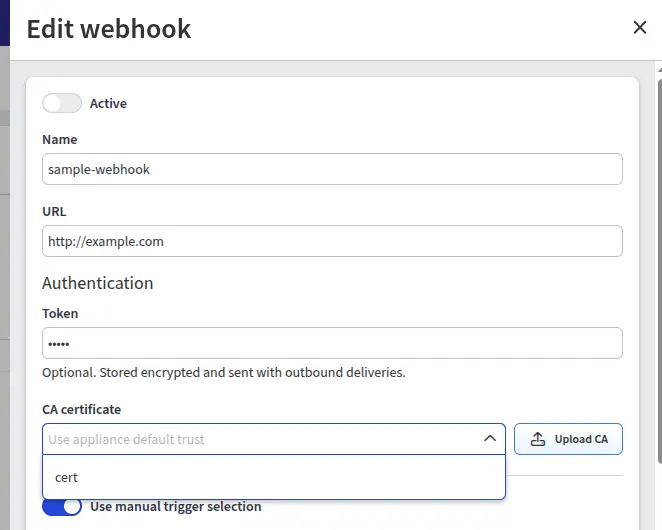
Uploaded certificate authorities are also managed in Settings → System → Certificate Authorities.
Note
A custom CA applies only to https:// endpoints. Publicly trusted
certificate authorities are always accepted, so a custom CA is only needed
for endpoints signed by a CA that is not publicly trusted.
Test Webhook
To test your webhook (even an inactive one), use the Test button in the UI.
Pick the webhook type and action and confirm the popup dialog. IP Fabric will
send a dummy payload corresponding to the selected webhook. To
distinguish the testing payloads from the real ones, IP Fabric adds the test: true
property to the testing messages.
After IP Fabric sends the test, a confirmation appears with a click here link. The link opens the Recent Deliveries tab filtered to that webhook, where you can view the test delivery and its result.
Webhook Types
Currently, the following webhook types are triggered by IP Fabric:
snapshot
The event is triggered upon network discovery and when manipulating snapshots.
{
  "type": "snapshot",
  "action": "discover" | "clone" | "delete" | "download" | "load" | "unload",
  "status": "started" | "completed" | "failed" | "resumed" | "resumed (stopping)" | "stopped",
  "reason"?: string,
  "requester": "cron" | "user:<id>",
  "snapshot"?: {
    "id": string,
    "name"?: string,
    "cloneId"?: string,
    "file"?: string,
  }
  "timestamp": number,
  "test"?: boolean
}
If the action has failed, the payload includes a top-level reason
field with a string describing why the action has failed.
The snapshot object is missing completely when the snapshot is not known
yet, e.g., when network discovery has just started.
When the clone action is completed, the snapshot object also contains
a cloneId field with the ID of the newly created (cloned) snapshot.
When the download action is completed, the snapshot object also includes
a file field with the filename of the created snapshot archive.
If you are testing the webhook, the test field is set to true.
intent-verification
The event is triggered when an intent verification is calculated.
{
  "type": "intent-verification",
  "action": "calculate",
  "status": "started" | "completed" | "failed" | "resumed" | "resumed (stopping)" | "stopped",
  "reason"?: string,
  "requester": "cron" | "user" | "snapshot:<action>" | "recalculateSites",
  "reportId"?: string,
  "snapshotId"?: string,
  "timestamp": number,
  "test"?: boolean
}
If the action has failed, the payload includes a top-level reason
field with a string describing why the action has failed.
When the intent verification is related to:
- a report, its ID is available as
reportId,
- a snapshot, its ID is available as
snapshotId.
If you are testing the webhook, the test field is set to true.
Custom Payload
For webhooks that use advanced trigger selection, you can replace the default
payload with your own template. Select the json or xml format and write the
body as a Mustache template. IP Fabric renders the template for each delivery.
The editor starts from a default template that reproduces the standard
payload, so you can adjust it from there.
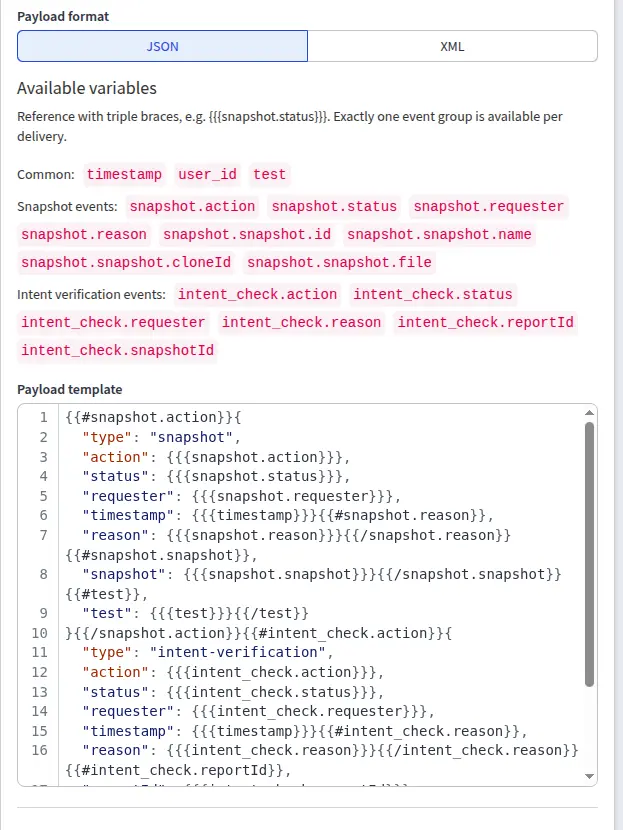
Reference event values with the triple-brace syntax {{{variable}}}. IP Fabric
encodes each value for the chosen format and inserts it as-is, so the rendered
payload stays valid json or xml. The following variables are available:
{{{timestamp}}},{{{user_id}}}, and{{{test}}}at the root,
- for snapshot events, the fields of the
snapshotpayload undersnapshot, e.g.{{{snapshot.action}}},{{{snapshot.status}}},{{{snapshot.snapshot.id}}},{{{snapshot.snapshot.cloneId}}}, and{{{snapshot.snapshot.file}}},
- for intent verification events, the fields of the
intent-verificationpayload underintent_check, e.g.{{{intent_check.action}}},{{{intent_check.status}}},{{{intent_check.reportId}}}, and{{{intent_check.snapshotId}}}.
The fields available for each event correspond to the payloads described in Webhook Types above.
{
  "event": {{{snapshot.action}}},
  "status": {{{snapshot.status}}},
  "snapshotId": {{{snapshot.snapshot.id}}},
  "at": {{{timestamp}}}
}
Note
Always use the triple-brace {{{variable}}} syntax, not {{variable}}. If
the rendered payload is not valid for the selected format, or the template
references an unknown variable, the delivery is recorded as failed and
nothing is sent.
Custom Headers
Webhooks that use advanced trigger selection can send additional outbound HTTP headers. Each header has a name and a value. IP Fabric renders the value as a Mustache template for each delivery.
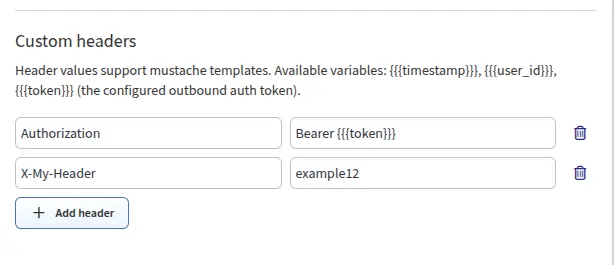
Header values support the {{{timestamp}}}, {{{user_id}}}, and {{{token}}}
(stored authentication token) variables. For example, an Authorization header
with the value Bearer {{{token}}} attaches the token to every call.
- Header names must be valid HTTP header names and must be unique.
- IP Fabric reserves
X-IPF-Signatureand you cannot override it.
- IP Fabric always sets
Content-Type,User-Agent, andX-IPF-Signature. You cannot override these headers.Content-Typefollows the selected payload format.