Shortest Path Bridging MAC (SPBM)
Shortest Path Bridging MAC mode (SPBM), defined in IEEE 802.1aq, is a Layer 2 fabric technology. It uses IS-IS as its control plane to build loop-free, shortest-path forwarding across the backbone. SPBM encapsulates customer traffic in a backbone MAC (MAC-in-MAC, 802.1ah) header. It forwards traffic between fabric nodes based on their backbone MAC (B-MAC) addresses.
A Service Instance Identifier (I-SID), a 24-bit value, identifies services and maps customer traffic to a specific service across the fabric. A backbone VLAN (B-VLAN) carries the encapsulated traffic for each I-SID.
Key Concepts
- B-MAC (Backbone MAC) – The MAC address that identifies a fabric node in the backbone. SPBM unicast forwarding is performed toward destination B-MACs.
- I-SID (Service Instance Identifier) – A 24-bit service identifier that uniquely represents a service instance across the fabric.
- B-VLAN (Backbone VLAN) – The VLAN used to transport the encapsulated backbone traffic between fabric nodes.
- Node System ID – The IS-IS system ID (a MAC address) that identifies a fabric node in the SPBM control plane.
- Fabric Area – The fabric area classification of an entry, either
HOME(the local fabric area) orREMOTE(reachable through another area). - L2 VSN (Layer 2 Virtual Services Network) – A Layer 2 service carried over the backbone. It maps a customer VLAN to an I-SID at the fabric edge.
- BEB (Backbone Edge Bridge) – A fabric node at the edge of the backbone. It adds the backbone header to customer traffic and removes it again.
- BCB (Backbone Core Bridge) – A fabric node inside the backbone. It forwards encapsulated traffic on the B-MAC and the B-VLAN alone.
Tabs in Technology → SPBM
The SPBM section has two tabs: Services and B-MAC Forwarding.
Services
The Services tab lists the I-SID service entries distributed by IS-IS across the fabric. Each entry maps an I-SID to a backbone VLAN and records the fabric node advertising the service. It also records the local access interfaces (SAPs) bound to it. The Entry Origin column indicates whether the entry is local (this device is the advertising node), learned (advertised by another fabric node but also configured locally on this device), or remote (advertised by another fabric node and not configured locally).
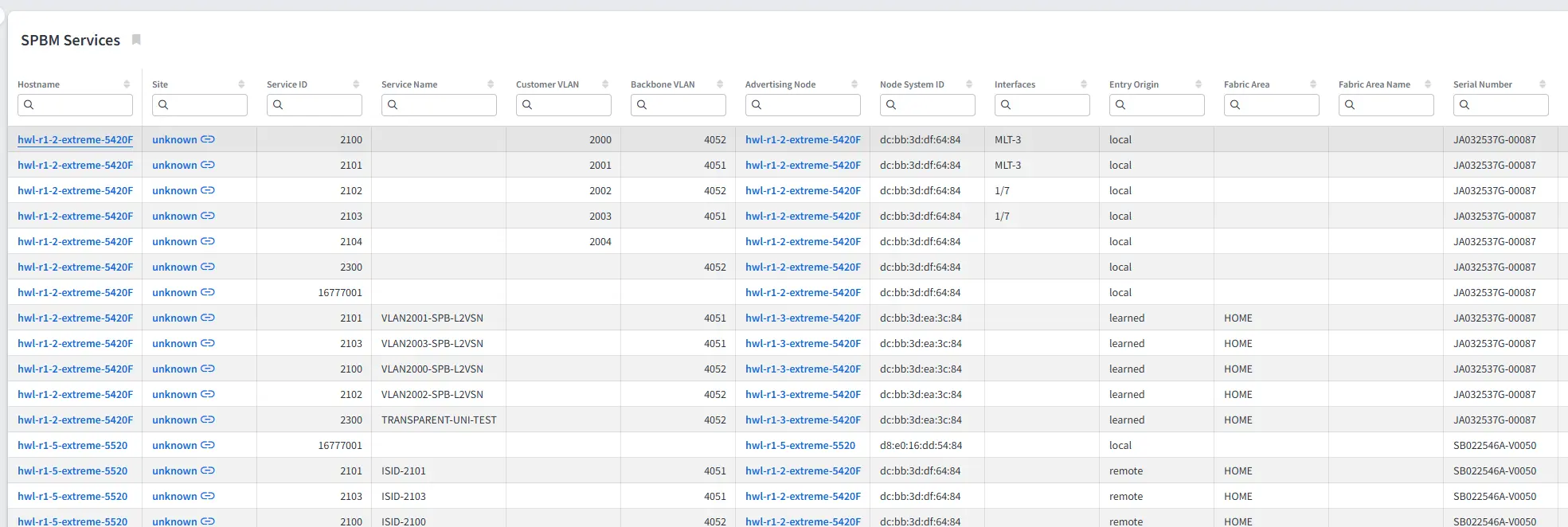
| Column | Description |
|---|---|
| Hostname | Device hostname from which IP Fabric collected the SPBM service data. |
| Site | Device site location. |
| Service ID | I-SID service identifier. |
| Service Name | Name associated with the I-SID service. |
| Customer VLAN | Customer VLAN mapped to the I-SID. |
| Backbone VLAN | Backbone VLAN used by the SPBM service. |
| Advertising Node | Hostname of the fabric node advertising this service entry. Links to the device when it exists in the snapshot. |
| Node System ID | System ID (MAC address) of the advertising node. |
| Interfaces | Local access interfaces (SAPs) bound to this I-SID on the advertising node. |
| Entry Origin | Origin of the service entry: local (this device is the advertising node), learned (advertised by another node and also configured locally here), or remote (advertised by another node, not configured locally). |
| Fabric Area | Fabric area classification (HOME or REMOTE). |
| Fabric Area Name | Fabric area name reported by the device. |
B-MAC Forwarding
The B-MAC Forwarding tab displays the SPBM underlay unicast forwarding entries toward destination backbone MAC addresses. Each entry records the destination B-MAC and the backbone VLAN. It also records the fabric node that owns the destination, the egress interface used to reach it, and the associated path metric (cost).
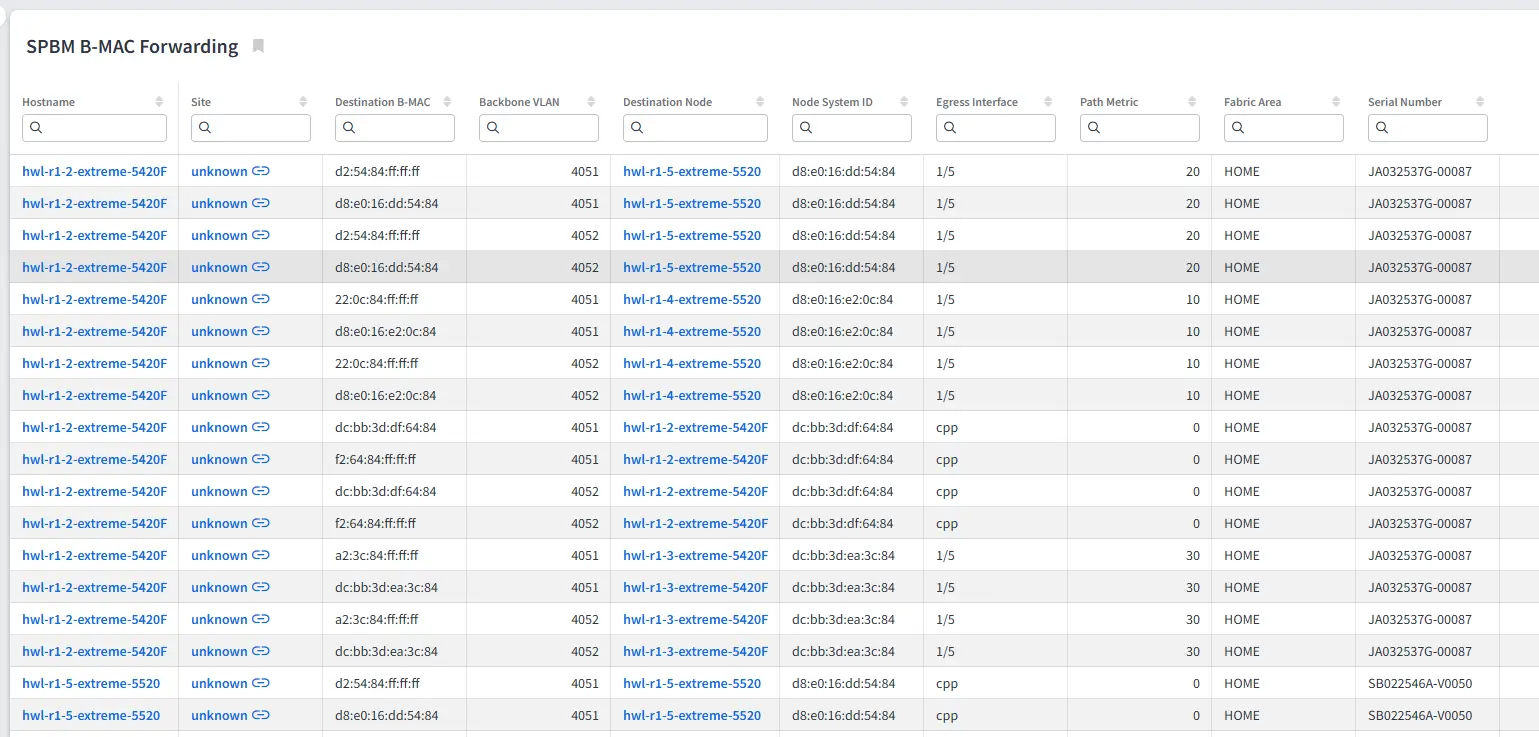
| Column | Description |
|---|---|
| Hostname | Device hostname from which IP Fabric collected the B-MAC forwarding data. |
| Site | Device site location. |
| Destination B-MAC | Destination backbone MAC address reachable in the underlay. |
| Backbone VLAN | Backbone VLAN used for the underlay forwarding entry. |
| Destination Node | Hostname of the fabric node that owns or advertises the destination. Links to the device when it exists in the snapshot. |
| Node System ID | System ID (MAC address) of the destination fabric node. |
| Egress Interface | Egress interface used to reach the destination B-MAC. |
| Path Metric | Path metric (cost) associated with the forwarding entry. |
| Fabric Area | Fabric area classification (HOME or REMOTE). |
Path Lookup
Since version 8.1, path lookup follows traffic through SPBM L2 VSN services. It also follows the service across fabric areas, so multi-area forwarding is traced end to end.
Path lookup resolves each hop from the collected SPBM data:
- Ingress BEB – The MAC table match returns the I-SID, the destination B-MAC, and the B-VLAN for the customer MAC address. Path lookup then adds the backbone header. The packet action shows the pushed header, and the Backbone stack in the packet detail shows
B-DA,B-SA,I-SID, andB-VLAN. - Transit BCB – Forwarding follows the B-MAC forwarding entry for the destination B-MAC and the B-VLAN. The customer header stays untouched.
- Egress BEB – Path lookup removes the backbone header. It then continues in the customer VLAN mapped to the I-SID.
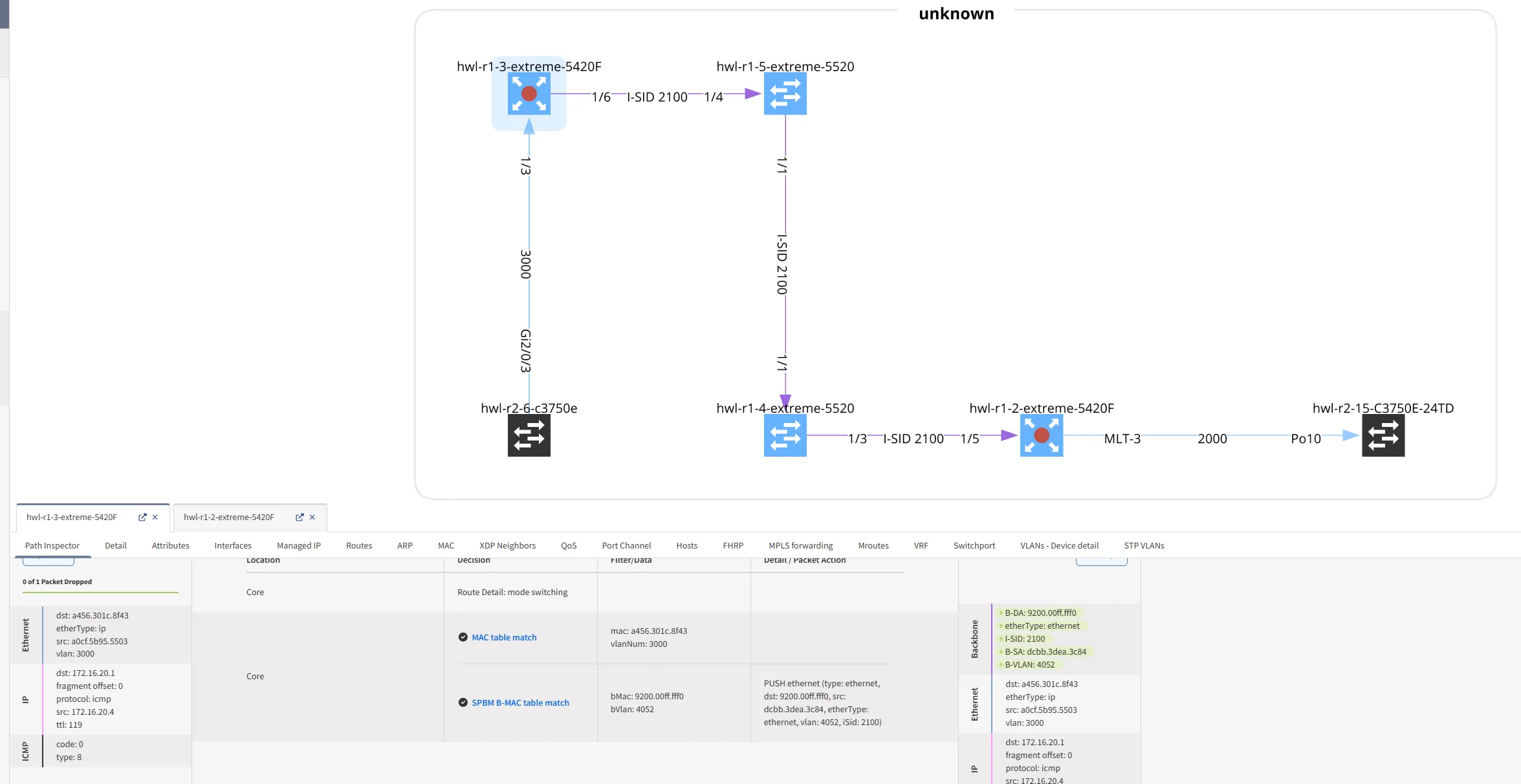
The topology view labels backbone links with the I-SID and access links with the customer VLAN. This makes the boundary between the customer service and the backbone visible in the diagram.
Fabric Edge Without STP
IP Fabric mainly uses STP to discover Layer 2 forwarding between switches. On a Switched UNI (S-UNI) port, the BEB maps customer VLANs to an I-SID. STP does not run between the BEB and the neighboring Ethernet switch.
Since version 8.2, IP Fabric closes this gap with a dedicated fabric-edge relation. It creates the relation when:
- LLDP connects a BEB port to a port on a standard Ethernet switch.
- The BEB port is an S-UNI port with a configured I-SID.
- The VLAN matches on both sides.
The relation covers physical ports and MLT aggregates. Path lookup uses it to cross from the Ethernet network into the SPBM fabric and back out.
LLDP Required
LLDP must be enabled on the S-UNI ports. Without an LLDP neighbor, IP Fabric cannot create the fabric-edge relation.
Vendor Support
SPBM data collection is currently supported on the following platforms:
- Extreme Networks VOSS
- Alcatel-Lucent Enterprise AOS / OmniSwitch
See the Feature Matrix for the most up-to-date list of supported vendors and features.